AutStr: Symbolic Infinite Structures in Python
 Image credit: ChatGPT
AutStr is a Python library for symbolic representation and manipulation of infinite relational structures. It represents infinite mathematical objects — the integers ℤ, the localizations ℤ[1/p], whole classes of finite graphs and groups — as finite automata, and lets you query them with first-order and monadic second-order logic. Because the representation is exact and the logic is decidable, a single small framework acts as several tools at once:
- 🧮 a computer algebra system for infinite domains — exact algebra over infinite sets and relations, not floating point;
- ⊢ a decision procedure / theorem prover — decide first-order and MSO statements over infinite structures (Presburger and Büchi arithmetic, MSO over graphs), returning a proof-carrying yes/no;
- 🔬 a finite algebra & model-theory system — decide a property across an entire family of finite structures with one compiled automaton;
- ⚙️ an algorithm synthesizer — turn a logical specification into a provably linear-time algorithm.
All four are the same underlying object — an automatic presentation — viewed from different angles.
Version 4.0 (August 2026) replaces formula strings with Python expressions, computes first-order interpretations (quotients included), and adds level 2 collapsible pushdown graphs whose reachability is first-order definable — the question a Turing machine’s configuration graph cannot be asked. See the release announcement.
Earlier milestones: uniformly automatic classes and a 10²–10³× faster batched-NumPy core (v2, July 2026), and the step from words to trees with MTBDD transitions (v3, July 2026).
Installation
pip install autstr              # NumPy-only core — installs anywhere
pip install autstr[jax]         # + JAX-accelerated batch word processing
pip install autstr[graphs]      # + networkx conversion for the graph classes
Requires Python 3.10–3.14.
Synthesizing linear-time algorithms
Write what you want as a logical formula; AutStr compiles it — once — into a finite automaton that decides it. On structurally restricted inputs (bounded tree-depth, bounded pathwidth) that automaton is a linear-time algorithm, even for properties that are NP-hard in general — a constructive, streaming form of Courcelle’s theorem.
import networkx as nx
from autstr.graphs import TreeDepthClass, TreeDepthGraph

cls = TreeDepthClass(3)

# Bipartiteness as a monadic second-order formula, compiled ONCE for the whole
# class into a 6-state automaton:
bipartite, _ = cls.evaluate(
    'exists c.(all x.(all y.((not E(x,y)) or '
    '((Subset(x,c) and (not Subset(y,c))) or '
    '((not Subset(x,c)) and Subset(y,c))))))')

triangle = TreeDepthGraph.from_networkx(nx.cycle_graph(3))
bipartite.accepts([(s,) for s in cls.advice(triangle)])   # False — in microseconds
Deciding the property on a graph is a single linear pass, and the work batches beautifully (optionally on a GPU via the JAX backend):
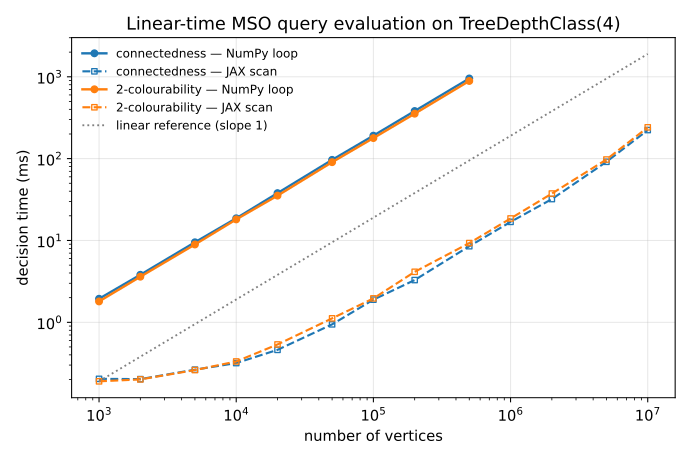
- Perfectly linear decision time (through-the-origin fit, R² = 1.0000); the JAX backend decides a million-vertex graph in ~20 ms per query.
- Batched evaluation classifies tens of thousands of graphs at once at ~90 million vertices / second — about 190× a naive per-graph loop.
Programming with infinite sets
Because relations are first-class infinite objects, you can also write algorithms that manipulate them directly. Here is the Sieve of Eratosthenes running over the actual infinite set of integers — no bound, no array:
from autstr.arithmetic import BuechiArithmeticZ

Z = BuechiArithmeticZ().symbolic()
x, y = Z.vars('x y')

def infinite_sieve(steps):
    candidates = x.gt(1)                          # the infinite set {2, 3, 4, ...}
    primes = []
    for _ in range(steps):
        for (p,) in candidates:                   # enumerates smallest-first
            primes.append(p); break               # ... so this is the next prime
        multiples = x.eq(primes[-1] * y).drop(y)
        candidates = candidates & ~multiples      # remove its multiples, symbolically
    return primes, candidates

primes, remaining = infinite_sieve(4)
# primes    == [2, 3, 5, 7]
# remaining  is the infinite set enumerating 11, 13, 17, 19, 23, 29, ...
Uniformly automatic classes
A uniformly automatic class presents an entire family of finite structures by giving every automaton an extra tape that reads an advice string. A query is compiled once for the class and then decides any member. Built-in classes cover:
| package | classes | signature |
|---|---|---|
autstr.graphs, autstr.tree_graphs | bounded tree-depth, pathwidth, tree-width, clique-width, rank-width | full MSO over vertex sets |
autstr.algebra | finite Boolean algebras, finite abelian groups, ℤ[1/p] | Meet/Join/Compl/Leq/Atom; + |
autstr.groups, autstr.tree_groups, autstr.cocycle_groups | index-≤2 cyclic groups (dihedral, quaternion, semidihedral, modular), extraspecial p-groups, class-2 groups of bounded rank-width over F_p or ℤ/pᵈ | multiplication M |
References
- Abu Zaid, F. Algorithmic Solutions via Model Theoretic Interpretations. Dissertation, RWTH Aachen University, 2016. DOI
- Abu Zaid, F. Uniformly Automatic Classes of Finite Structures. FSTTCS 2018. DOI
- Abu Zaid, F., Grädel, E., & Reinhardt, F. Advice Automatic Structures and Uniformly Automatic Classes. CSL 2017. DOI
- Blumensath, A., & Grädel, E. Automatic Structures. LICS 2000. URL
- Khoussainov, B., & Nerode, A. Automatic presentations of structures. LCC 1994. DOI
- Khoussainov, B., Rubin, S., & Stephan, F. Automatic Structures: Richness and Limitations. LMCS 2007. arXiv DOI