AutStr 4.0 — A Fruitful Summer: Trees, Rank-Width, and Decidable Reachability

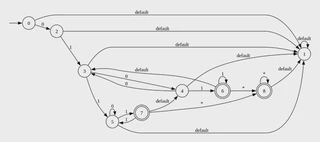 The integers greater than 1 divisible by neither 2 nor 3 — an infinite set as a nine-state automaton, computed by AutStr
This has been an unusually fruitful summer for AutStr. Four major releases landed between early July and mid-August, each building on the one before:
| 2.0 | 7 July | uniformly automatic classes; a 10²–10³× faster batched-NumPy core |
| 3.0 | 10 July | from words to trees; transitions become shared decision diagrams; composition |
| 3.1 | 19 July | bounded rank-width groups and graphs; the chain-ring extension; implicit evaluation |
| 4.0 | 13 August | symbolic queries; computed interpretations; infinite graphs and decidable reachability |
Only 2.0 got an announcement of its own, so this post covers everything since — the two releases in between, and then 4.0 in full.
pip install autstr · GitHub: fariedabuzaid/AutStr
· Documentation
3.0 — from words to trees
Version 2 presented infinite structures as automata reading words. Version 3 added the tree counterpart of the entire stack: bottom-up tree automata, tree-automatic presentations, and uniformly tree-automatic classes. That is the step from Büchi’s theorem to Rabin’s, and it buys structures that no word automaton can present — Skolem arithmetic (ℕ, ·), where a number is the tree of its prime exponents, and graphs of bounded tree-width and clique-width with full MSO. It was cross-validated by embedding the word engine’s Büchi arithmetic into the tree engine and re-deciding every sentence through both.
Underneath both engines, a transition stopped being a symbol → target table
and became a shared multi-terminal decision diagram over the symbol’s
digits — the representation MONA uses, for MONA’s reason: over a convolution
alphabet the flat table is the bottleneck. Queries that had been impossible for
lack of alphabet width suddenly compiled. An arity-5 relation over a 14-letter
alphabet — 14⁵ = 537 824 flat symbols — went from infeasible to 0.2 s, and
tree-depth-4 bipartiteness from 17 s to 0.4 s.
Version 3.0 also added autstr.composition: disjoint unions and direct products
of structures, and unions and product closures of whole classes. Composed, they
present every finite direct product of index-≤2 cyclic and extraspecial
p-groups — and decide that such a product is abelian exactly when all of its
factors are.
3.1 — rank-width, and queries that build no automaton
Where tree-width bounds how much combinatorial structure crosses a cut,
rank-width bounds the linear-algebraic rank of what crosses. Version 3.1
presented both graphs and groups by that measure from one body of machinery:
RankWidthClass for graphs, and class-2 groups of bounded rank-width whose
advice spells out rank-≤r factorizations of the commutation form’s crossing
blocks, cut by cut. The chain-ring extension then generalised all of it from
F_p to ℤ/p^d — Smith normal form, saturated interfaces, widths measured as
module cut-rank — and is byte-identical at d = 1.
The other half of 3.1 was implicit evaluation. Some members of these classes
have automata far too large to build. check_implicit and evaluate_implicit
decide first-order formulas and compute satisfying sets without ever building a
query automaton — or even a base automaton — reaching members that are
otherwise entirely out of reach.
4.0 — the symbolic release
Which brings us to today. Where 2.0 made the engine fast and 3.0 took it to trees, version 4 is about how you talk to it — and about two structures that sit right at the edge of what first-order logic can decide.
Write the mathematics, not the formula string
Queries used to be strings. Now every structure hands out variables that compose with ordinary Python operators, and every structure declares its own operators and its own codec — so the values you put in are the values you get back:
from autstr.arithmetic import BuechiArithmeticZ

Z = BuechiArithmeticZ().symbolic()      # (ℤ, +, <, |₂); no setup required
x, y, z = Z.vars('x y z')

R = (x + y + 3).lt(2 * x)     # the infinite set { (x, y) : x + y + 3 < 2x }
R.is_empty()                  # False
(0, 4) in R                   # False   — membership test

band = (x + y).eq(z) & z.gt(0) & z.lt(3)   # x + y = z ∧ 0 < z < 3
for s, _ in zip(band.drop(z), range(3)):   # ∃z, then enumerate smallest-first
    print(s)                               # (0, 1), (1, 0), (1, 1)
Nothing is materialised until you iterate; & | ~ are exact operations on
infinite sets. The same expressions work over any structure or class in the
library, on either the word or the tree engine. Over the finite-powerset
structure, for instance, the Boolean operations are the arithmetic ones:
from autstr.powerset import MSO0

a, b, c = MSO0().symbolic().vars('a b c')   # finite sets of naturals
({0, 1}, {1, 2}, {0, 1, 2}) in (a + b).eq(c)       # union — True
By Büchi’s theorem, first-order logic over that structure is monadic second-order logic over (ℕ, <) — so quantifying over sets there costs no more than quantifying over elements does elsewhere.
Structures defined inside other structures
Automatic structures are closed under first-order interpretation. AutStr 4.0
does not merely record that fact — interpret computes the interpreted
presentation from a domain formula, a formula per relation, a dimension, and
optionally a definable equivalence whose classes become the elements.
The textbook example is the construction of the integers from the naturals: a pair (a, b) stands for a − b, and two pairs denote the same integer when a + d = c + b. That is a two-dimensional quotient interpretation, and it runs.
Quotients need one representative per class. Over words that is the shortlex-least member. Over trees no automatic order is well-founded — growing a tree where two members differ makes it smaller — so a class may have no least member at all, and the representative is instead the least description (Kuske & Weidner). Both work.
The ordinals are the payoff: by Cantor normal form an ordinal below ωn
is an n-tuple of naturals in reverse-lexicographic order, so autstr.ordinals
is three formulas over Büchi arithmetic with no automaton written by hand.
from autstr.ordinals import Ordinal

p, q = Ordinal(2).symbolic().vars('p q')   # the ordinals below ω²
((0, 5), (1, 0)) in p.lt(q)                # 5 < ω  — True
How far that reaches is exactly Delhommé’s theorem: the word-automatic ordinals are those below ωω, the tree-automatic ones those below ωωω.
Where first-order logic stops — and where it doesn’t
This is my favourite part of the release, because the two new structures make a sharp contrast.
A Turing machine’s configuration graph is automatic: a configuration is a state, a tape and a head position, one step rewrites a bounded window, and the whole first-order theory is decidable. What you may not ask is whether one configuration reaches another — that is the halting problem, and no first-order formula over this graph can express it.
Level 2 collapsible pushdown graphs are where that changes. Their stacks are stacks of stacks whose letters carry collapse links, and their configuration graphs are tree-automatic by Kartzow’s encoding — blocks hang off each other as a tree, and the links are recovered from its shape rather than stored. Since MSO over these graphs is undecidable, the tree encoding is the only automatic route to them.
And there, reachability is a relation of the graph like any other:
from autstr.collapsible import Level2CPS

system = Level2CPS([('0', None, 'c', '1', 'clone'),
                    ('1', None, 'o', '0', 'pop 2')], symbols=('a',))
graph = system.configuration_graph()

graph.presentation.relation('Reach')       # 29 states, built in 0.5 s
graph.check('all x.(all y.(all z.((Reach(x,y) & Reach(y,z)) -> Reach(x,z))))')
# True — transitivity, over all configurations and all runs of any length
That last line is worth pausing on. It is a statement about every run between every pair of configurations, decided by automata operations in under a second — and it is not a test that passed, it is a theorem that was proved.
Following Kartzow, reachability is not a fixpoint over trees but a decomposition: every run splits into four stretches — words leaving the stack, letters leaving, letters returning, words returning — each relation reflexive, so
$$\mathrm{Reach}(x,y) \;=\; \exists d\, \exists f\, \exists g.\; A(x,d) \wedge B(d,f) \wedge C(f,g) \wedge D(g,y)$$is a first-order formula over four automata. It is exponential in the number of control states, so it is declared up front and built the first time a query mentions it.
Also new
- The countable atomless Boolean algebra — the clopen algebra of Cantor space, where every nonzero element splits forever, on the tree engine.
- Infinite graphs — the Cayley graph of ℤⁿ and the infinite k-regular tree with its prefix order.
- Serialization for the tree engine, so an expensive relation is built once and kept.
Breaking changes
autstr.buildin is gone: every structure the library ships is built in, so the
name carved nothing, and its contents moved to modules named for their subject —
autstr.arithmetic, autstr.powerset, autstr.tree_arithmetic. The
changelog
has the upgrade path.
One fix worth calling out for 3.x users: a sentence used as an operand of a
connective — (all x.(...)) & (exists y.(...)) — used to raise IndexError. It
works now, on both engines.
An experiment in AI-assisted algorithm engineering
Each major AutStr release doubles as a snapshot of what a frontier AI coding system can do on hard, verifiable algorithmic work, with the mathematical direction and review kept firmly human. That is what made this summer possible: four major releases in five weeks, each a focused session in Claude Code — the tree engine and the decision-diagram rewrite in 3.0, the rank-width families and the chain-ring generalisation in 3.1, and in 4.0 the symbolic layer, the interpretation machinery, Kartzow’s reachability construction worked through from the paper, and a serializer for the tree engine.
Several of the constructions realised over these weeks were sketched on a whiteboard a decade ago and never implemented; some went from that sketch to running, tested code within hours.
The part I found most instructive was not the new code but what writing the documentation uncovered. Building the worked examples for the notebooks turned up three genuine defects that the 850-test suite had never touched — including enumeration being silently broken for every interpreted structure of dimension greater than one, in a released version, because membership queries happened to take a different code path. A good example exercises a library in ways a test suite does not.
The code is the model’s; the theory, the choices, and the verification protocol are human.
Who is it for?
AutStr is built for researchers and practitioners in algorithmic model theory, logic, and theoretical computer science — anyone exploring computable infinite structures, or turning declarative specifications into optimal streaming algorithms.
Install with pip install autstr and see the project page,
the documentation, and the
showcase notebooks
to get started.
