AutStr 2.0 — Uniformly Automatic Classes and Linear-Time Algorithm Synthesis

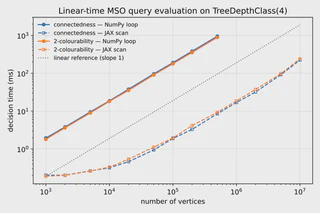 Linear-time MSO query evaluation on graphs of bounded tree-depth (AutStr benchmark suite)
I’m excited to announce AutStr 2.0, a major release of the Python library for symbolic computation over infinite mathematical structures using automata theory. Version 2 is both a large capability jump and a near-complete rewrite of the engine underneath.
pip install autstr · GitHub: fariedabuzaid/AutStr
One formalism, four roles
AutStr represents infinite structures — the integers ℤ, the localizations ℤ[1/p], whole classes of finite graphs and groups — as finite automata, and lets you query them with first-order and monadic second-order logic. Because the representation is exact and the logic is decidable, a single small framework acts as several tools at once:
- 🧮 a computer algebra system for infinite domains — manipulate infinite sets and relations with exact algebra, not floating point;
- ⊢ a decision procedure / theorem prover — decide first-order and MSO statements over infinite structures (Presburger and Büchi arithmetic, MSO over graphs), returning a proof-carrying yes/no;
- 🔬 a finite algebra & model-theory system — decide a property across an entire family of finite structures (all finite abelian groups, all graphs of bounded tree-depth) with one compiled automaton;
- ⚙️ an algorithm synthesizer — turn a logical specification into a provably linear-time algorithm.
All four are the same underlying object — an automatic presentation — viewed from different angles.
What’s new in 2.0
⚙️ Uniformly automatic classes. The centrepiece of this release. A uniformly automatic class presents not one structure but an entire family, by giving every automaton an extra tape that reads an advice string synchronously with the elements. A query is compiled once for the class and then decides any member. Ready-made classes ship for:
- graphs of bounded tree-depth and pathwidth, with full MSO over vertex sets;
- finite Boolean algebras, finite abelian groups, and the ℤ[1/p] localizations;
- non-abelian groups — dihedral, quaternion, semidihedral, modular, and extraspecial p-groups.
🚀 A rewritten automata core. The entire engine is now a batched, sparsity-aware NumPy implementation of sparse DFAs — a 10²–10³× speedup over v1 (the reference query dropped from 85 s to 0.03 s), with linear memory. JAX moved from a hard dependency to an optional accelerator for bulk word processing.
📐 Algorithm synthesis in practice. Write what you want as a logical formula; AutStr compiles it once into an automaton that decides it. On structurally restricted inputs (bounded tree-depth, bounded pathwidth) that automaton is a linear-time algorithm — even for properties that are NP-hard in general, such as 3-colourability. This is a constructive, streaming form of Courcelle’s theorem.
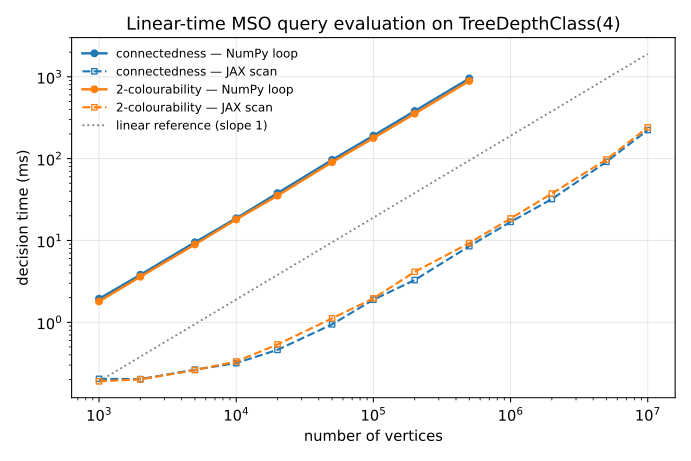
The benchmark suite (reproducible in benchmarks/)
measures this directly:
- Perfectly linear decision time — a through-the-origin fit of R² = 1.0000 across three orders of magnitude; the JAX backend decides a million-vertex graph in ~20 ms per query.
- Batched evaluation classifies tens of thousands of graphs at once at ~90 million vertices / second — about 190× a naive per-graph loop.
A quick taste
Bipartiteness as a monadic second-order formula, compiled once for the whole class of tree-depth-≤3 graphs into a 6-state automaton, then decided on any graph in a single linear pass:
import networkx as nx
from autstr.graphs import TreeDepthClass, TreeDepthGraph

cls = TreeDepthClass(3)
bipartite, _ = cls.evaluate(
    'exists c.(all x.(all y.((not E(x,y)) or '
    '((Subset(x,c) and (not Subset(y,c))) or '
    '((not Subset(x,c)) and Subset(y,c))))))')

triangle = TreeDepthGraph.from_networkx(nx.cycle_graph(3))
bipartite.accepts([(s,) for s in cls.advice(triangle)])   # False — in microseconds
An experiment in AI-assisted algorithm engineering
Each major AutStr release doubles as a snapshot of what a frontier AI coding system can do on hard, verifiable algorithmic work, with the mathematical direction and review kept firmly human. Version 2.0 came out of an intensive two-day pair-programming session inside Claude Code with Anthropic’s Fable 5 model: it profiled and rewrote the automata core, migrated the JAX dependency, and built the entire uniformly-automatic layer — each class verified against exhaustive or exact ground-truth oracles. Several constructions the author had sketched a decade earlier went from a whiteboard description to running, tested code within hours. The code is the model’s; the theory, the choices, and the verification protocol were human.
Who is it for?
AutStr is built for researchers and practitioners in algorithmic model theory, logic, and theoretical computer science — anyone exploring computable infinite structures or looking to turn declarative specifications into optimal streaming algorithms.
Install with pip install autstr and see the project page and
the showcase notebooks
to get started.
